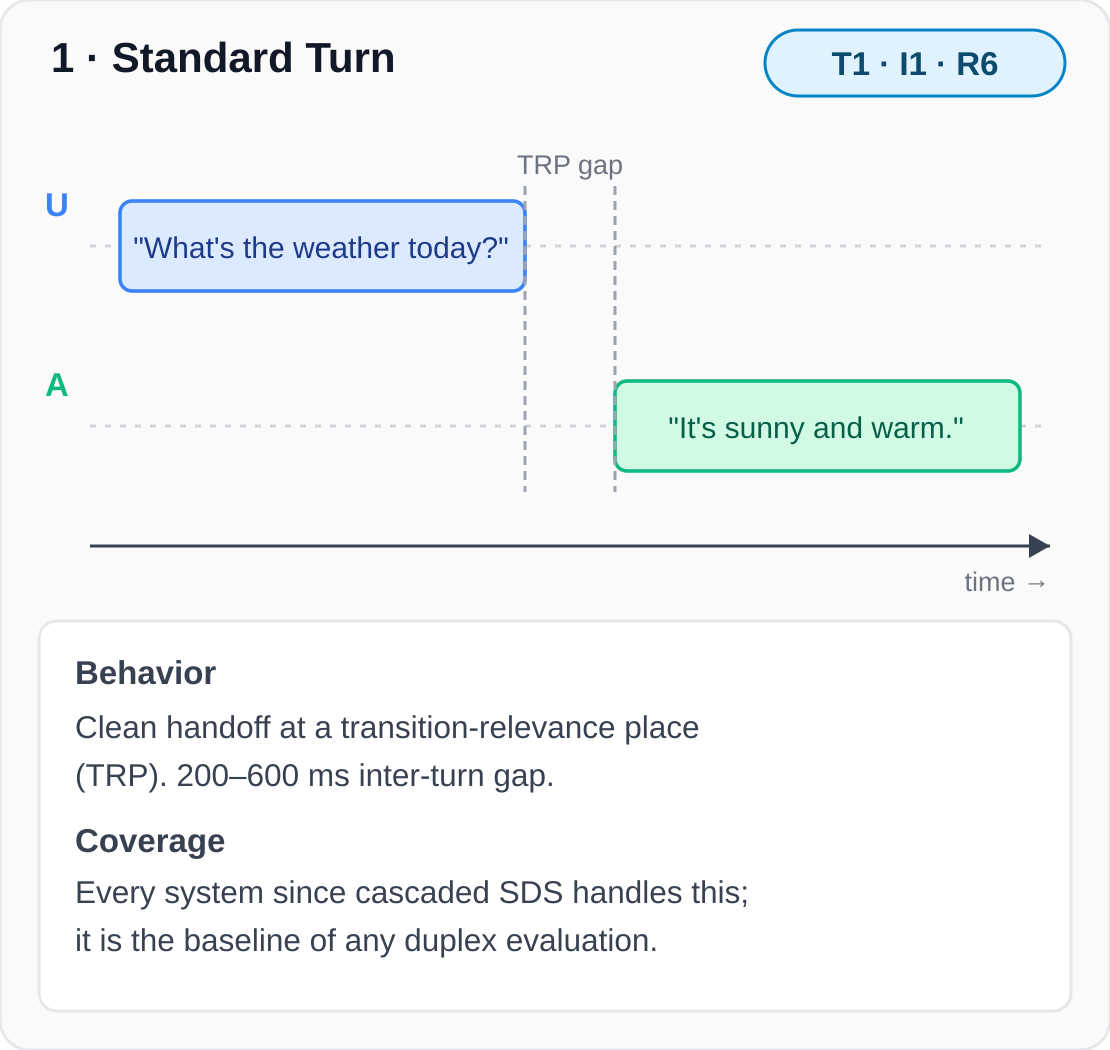
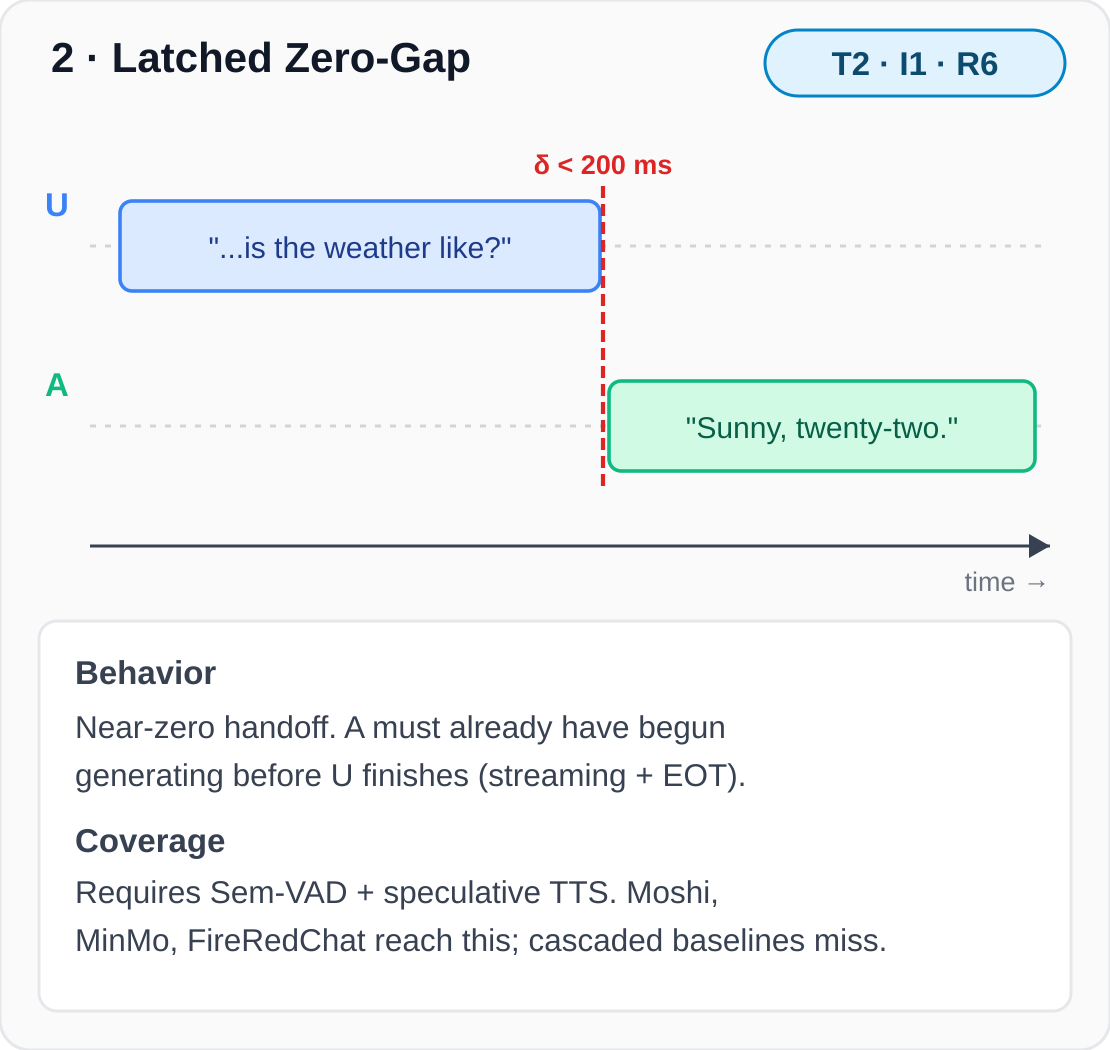
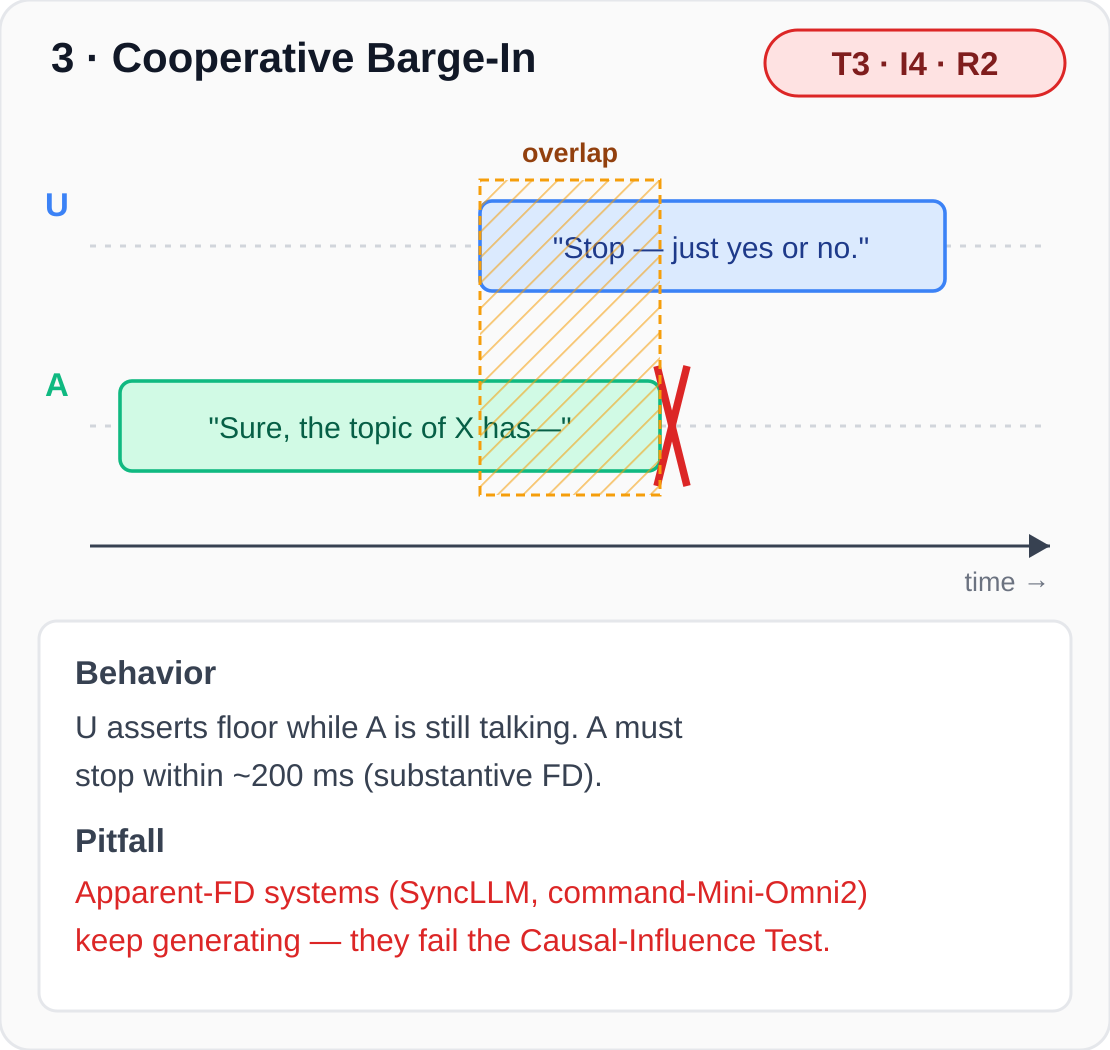
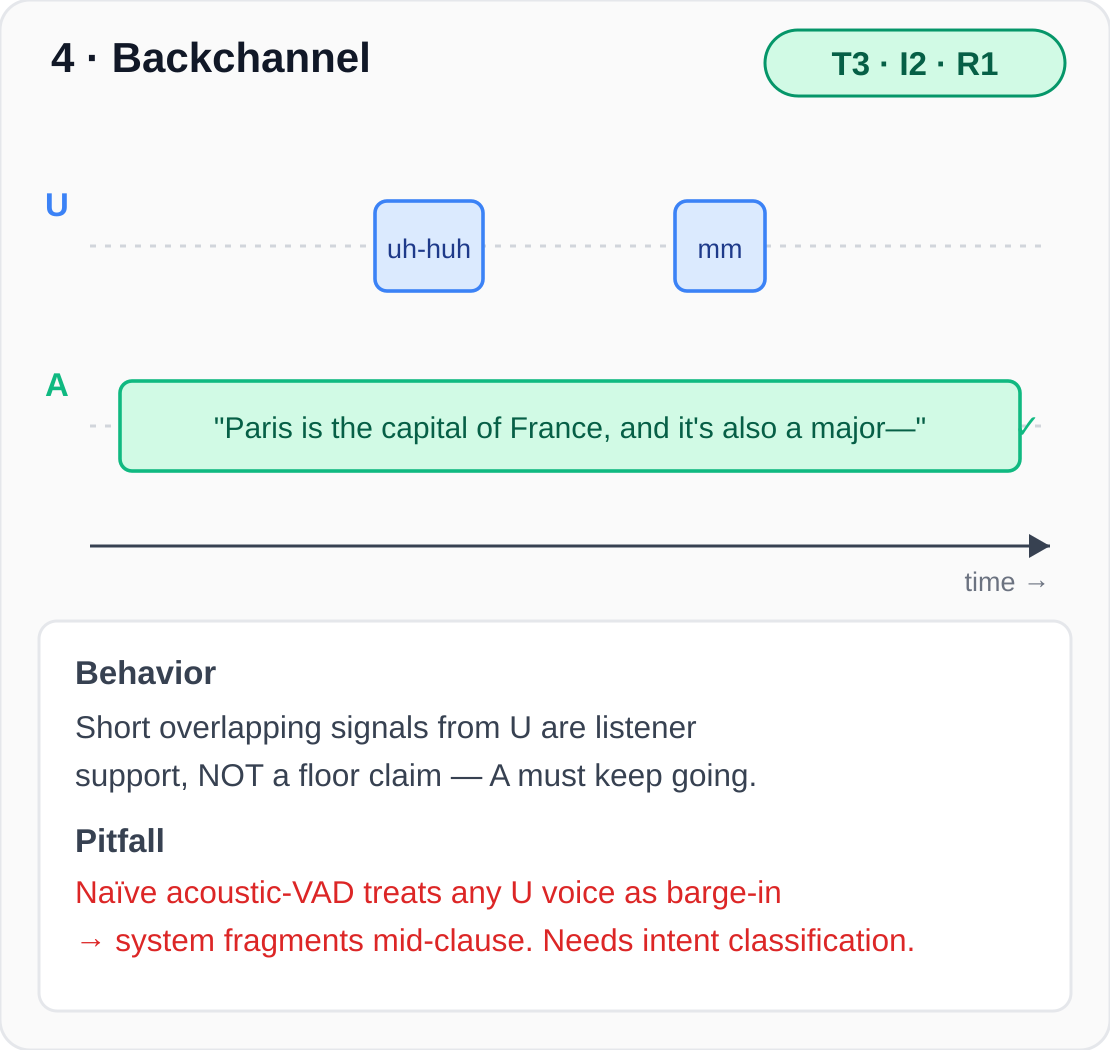
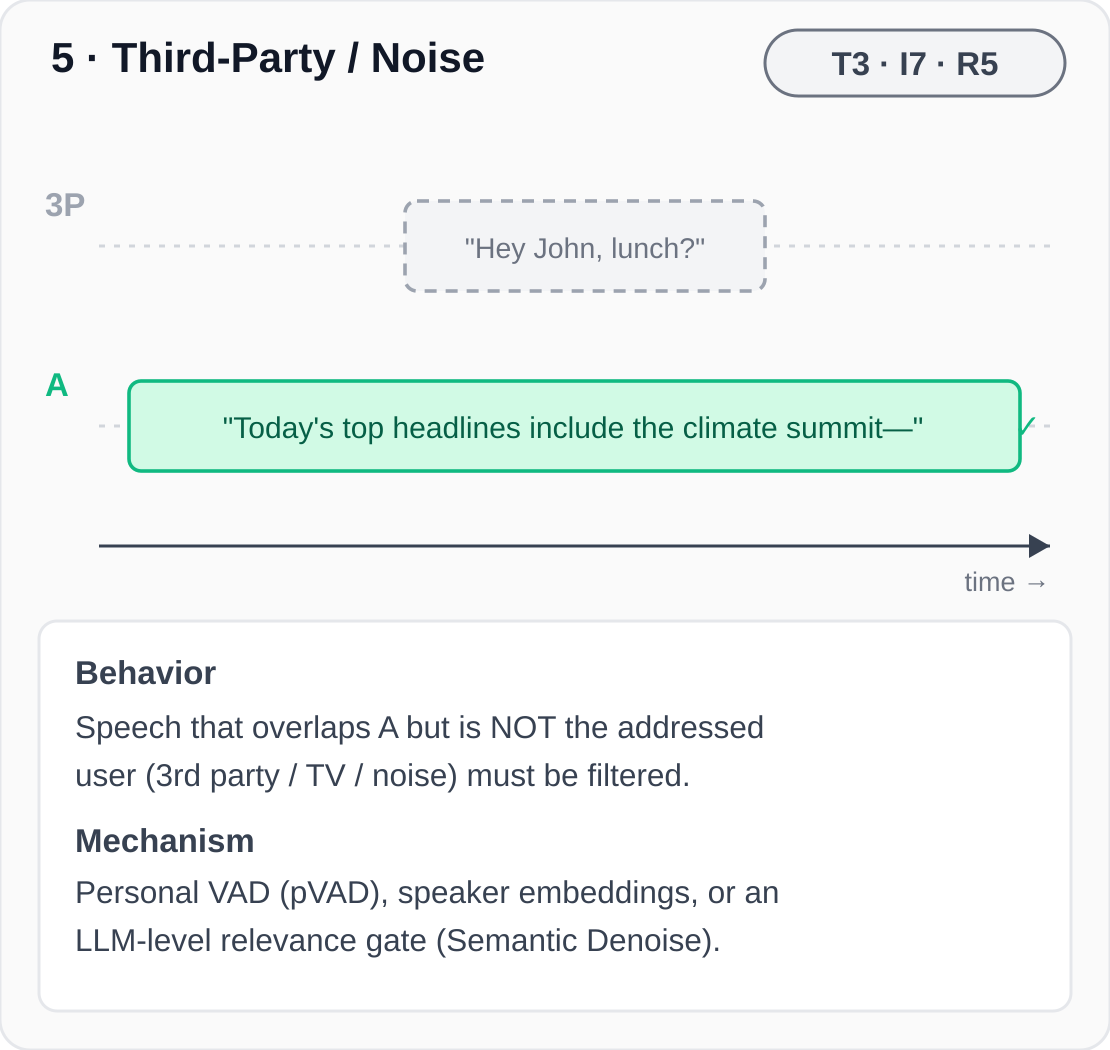
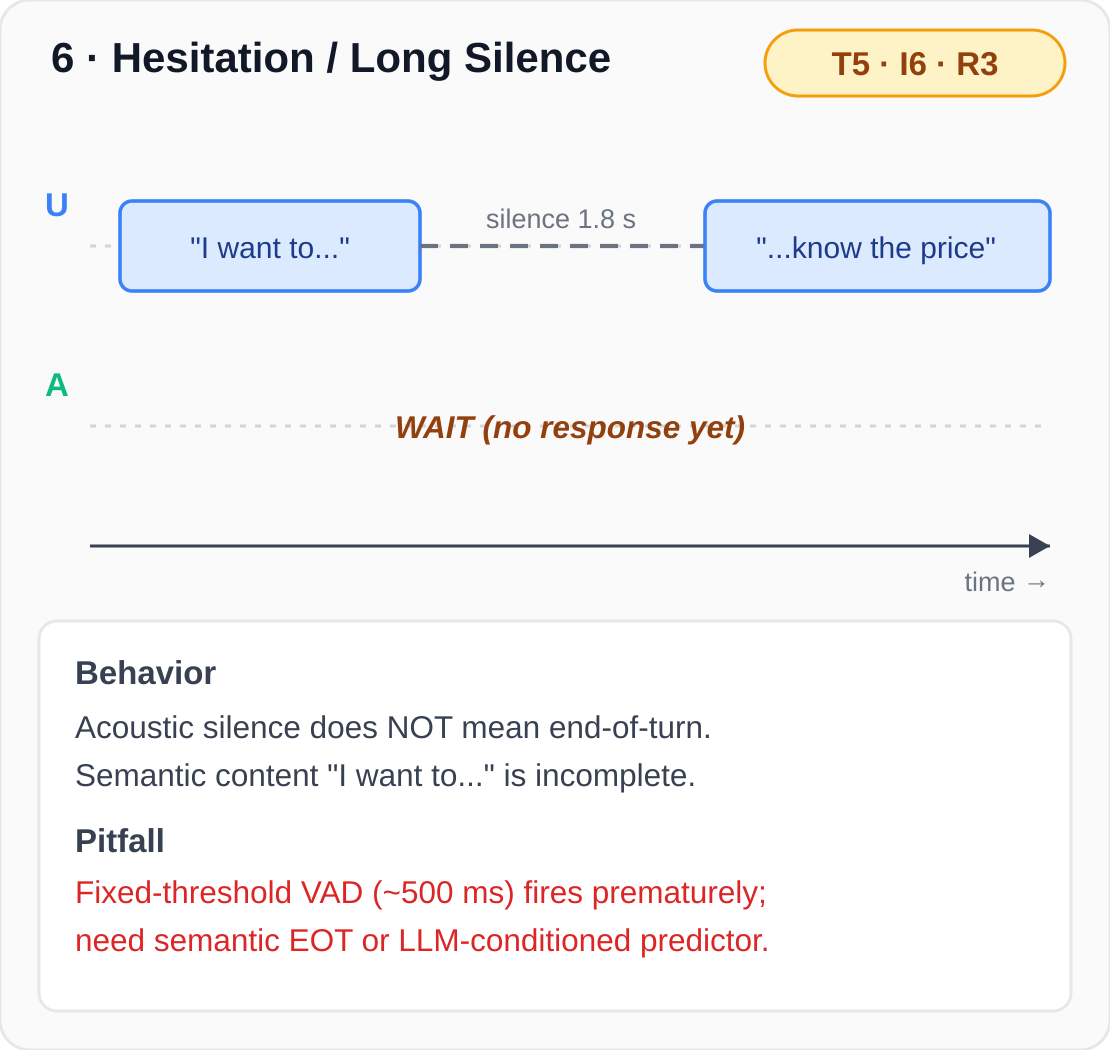
Interactive demo for the T × I × R ontology — each cell shows one
canonical scenario as a dual-channel waveform synced to its audio.
Click ▶ to play; click any waveform to seek.
📐 Three-axis ontology
Each conversational micro-event = (Temporal · Intent · Response) triplet.
Failure modes localise to specific cells in this 3-axis space, making them
diagnosable rather than vague.
T Temporal — when
T1
Sequential — 200-1500 ms inter-turn gap
T2
Latched — gap < 200 ms
T3
Overlap-onset — one party begins while the other is talking
T4
Concurrent — both ≥ 1 s sustained overlap
T5
Silence — both quiet ≥ 500 ms
I Intent — what for
I1
Information — primary content
I2
Backchannel — "uh-huh", "嗯", no floor claim
I3
Repair — self-correction or clarification
I4
Floor-claim — barge-in to take turn
I5
Floor-yield — release turn to other party
I6
Hesitation — mid-utterance pause, not done
I7
Third-party — non-addressed speech / noise
R Response — system action
R1
Continue — keep talking
R2
Stop & listen — yield within ~200 ms
R3
Wait — stay silent, user not finished
R4
Acknowledge — emit backchannel only
R5
Ignore / filter — drop non-addressed audio
R6
Initiate — start a new turn
Why three axes, not flat categories?
The same (Intent, Response) pair has different correctness depending on Temporal context.
Example: (I2, R1) = "user backchannel, assistant continues" is correct
during T3 (overlap-onset) but wrong during T1 (sequential turn,
where the same "uh-huh" might be the user yielding/closing).
🎧 Six canonical scenarios
Left channel = User / Third-PartyRight channel = Assistant